Quick answer: use the SOFT rewrite
- Situation: name one concrete moment.
- Own impact: say how it affected you in first-person language.
- Forward ask: request one specific next-step behavior.
- Trim extras: remove stacked topics and loaded words.
Opinionated take: in hard text exchanges, the first sentence matters more than your strongest argument. If the opener sounds like accusation, people defend themselves before they process your actual point.
The SOFT method works because it moves your message from character judgment to observable moment + impact + request. That structure is easier to respond to without escalating.
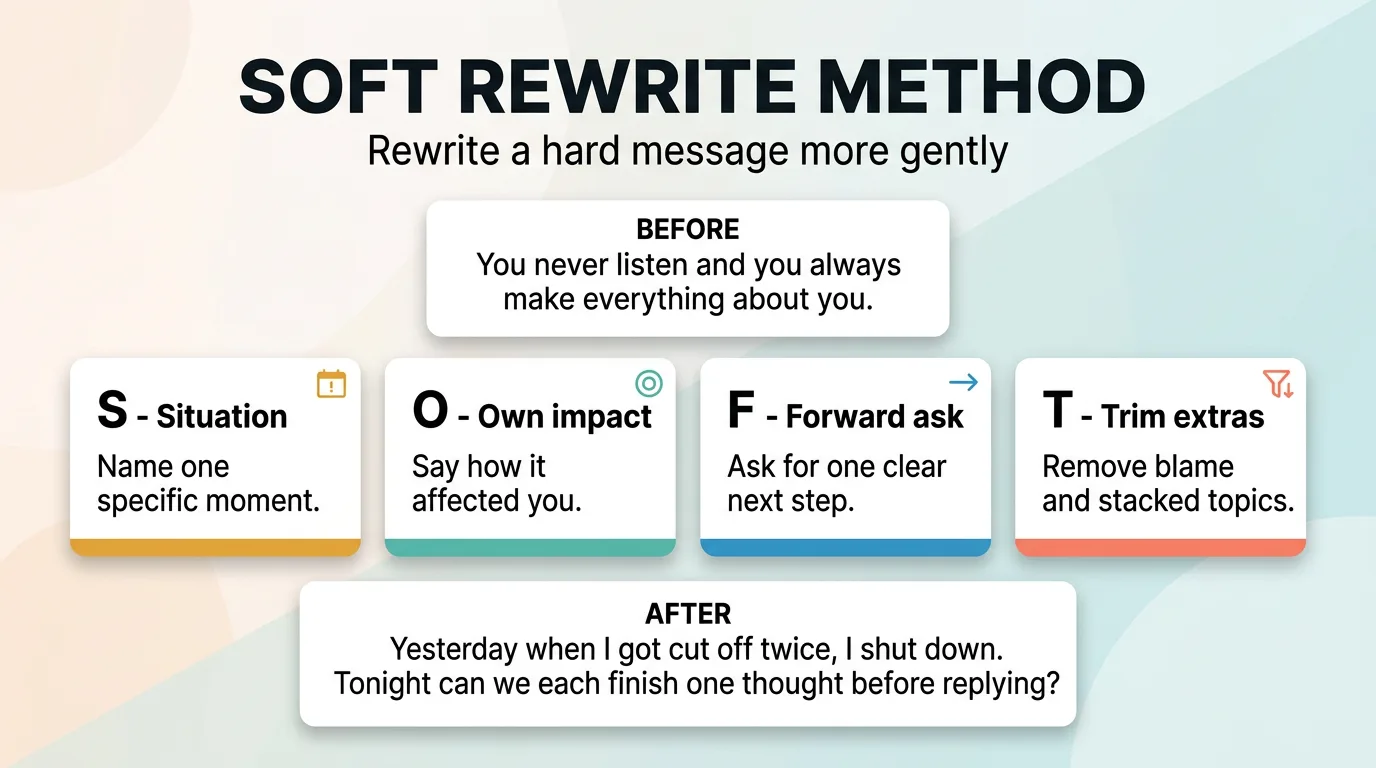
Step 1: Situation (one concrete moment)
Draft your raw version privately, then rewrite the opening as one specific event. Avoid global labels like always, never, selfish, or careless.
Step 2: Own impact (one feeling, one effect)
Say how the moment landed for you without mind-reading their intent. A single impact sentence is clearer than five lines of historical evidence.
Step 3: Forward ask (one practical request)
End with one practical request tied to the next relevant moment. If your request is specific and time-bound, your partner can actually act on it.
Step 4: Trim extras (one issue only)
Remove old grievances, sarcasm, and side topics. One text should carry one issue. Stacked topics feel like courtroom evidence, not a problem you can solve together.
Common rewrite mistakes that still trigger a fight
- You replaced insults but kept hidden blame, like "I am sorry you felt that way." That still sounds like the problem is their reaction.
- You sent a wall of text with six grievances. Length often reads like prosecution, even when your points are valid.
- You asked for a personality shift, not a behavior change. "Be more considerate" is vague; "text me by 6 if plans move" is actionable.
- You hit send while flooded. A two-minute pause catches words you would not choose in a calmer state.
Copyable rewrite example 1: late plan change
Before: "You clearly do not care about my time. You always do this."
After: "When plans changed at 7:40 and I found out at the last minute, I felt dismissed. Next time, can you text me as soon as you know so we can adjust together?"
Copyable rewrite example 2: feeling interrupted
Before: "You never listen and you make everything about you."
After: "Yesterday when I got cut off twice, I shut down and stopped sharing. Tonight can we try finishing one thought each before replying?"
Template bank: copy and customize one detail
Household load: "When dishes were left overnight three times this week, I felt overloaded. Can we pick who handles kitchen cleanup each night before dinner?"
Plans and timing: "When dinner plans changed after 7 without a heads-up, I felt unimportant. Next time, can we send a quick update as soon as plans shift?"
Tone during conflict: "When voices got loud yesterday, I shut down and stopped listening. If tone spikes tonight, can we pause for five minutes and restart calmer?"
30-second send check
- Would a neutral observer know exactly which moment you mean?
- Did you describe impact without labeling your partner's character?
- Did you ask for one behavior change, not a personality change?
- Is this message short enough to read once without scrolling?
Mini channel chooser: text now or talk live?
- Use text now when your goal is a calm opener, a scheduling ask, or one concrete request.
- Move to live talk when you need nuance, accountability, or repair after a bigger rupture.
- If in doubt, send a short opener by text and suggest a 10-minute call window.
If they still respond defensively
Even a careful rewrite can fail when timing is off or stress is high. If the first reply is sharp, send one reset line and narrow again: "I am not trying to attack you. I want us to solve one thing from tonight. Can we reset and keep it to this one issue?"
If the tone keeps climbing, switch channels: "I care about this, and text is making it worse. Can we do a 10-minute call later tonight?"
If you already sent the harsh version
You can still recover. Send a quick repair text before restating your point: "I sent that in frustration and the wording was harsh. I want to try again clearly." Then resend using SOFT.
If both sides are activated, prioritize de-escalation over persuasion. Use a shorter reset now, then return to content later. If you need a post-argument flow, use the conflict repair script for couples.
When text is the wrong channel
Text is good for a calm opener and a clear request. It is usually bad for high-context history, apology depth, or conflict repair after a blowup. Use text to open, then move to a short live conversation.
FAQ: rewriting a hard message gently
What if my partner still gets defensive after a gentle rewrite? Use a short reset line and narrow to one issue. If tone stays high, pause and continue live later instead of forcing a long text thread.
How long should a hard text message be? Usually three to five sentences. One moment, one impact sentence, one request.
Should I send a hard message late at night? Usually no. A calmer time window makes cooperative responses more likely.
If you want broader support beyond rewriting, see how to talk to your partner without starting a fight and how to bring up a sensitive topic with your partner.