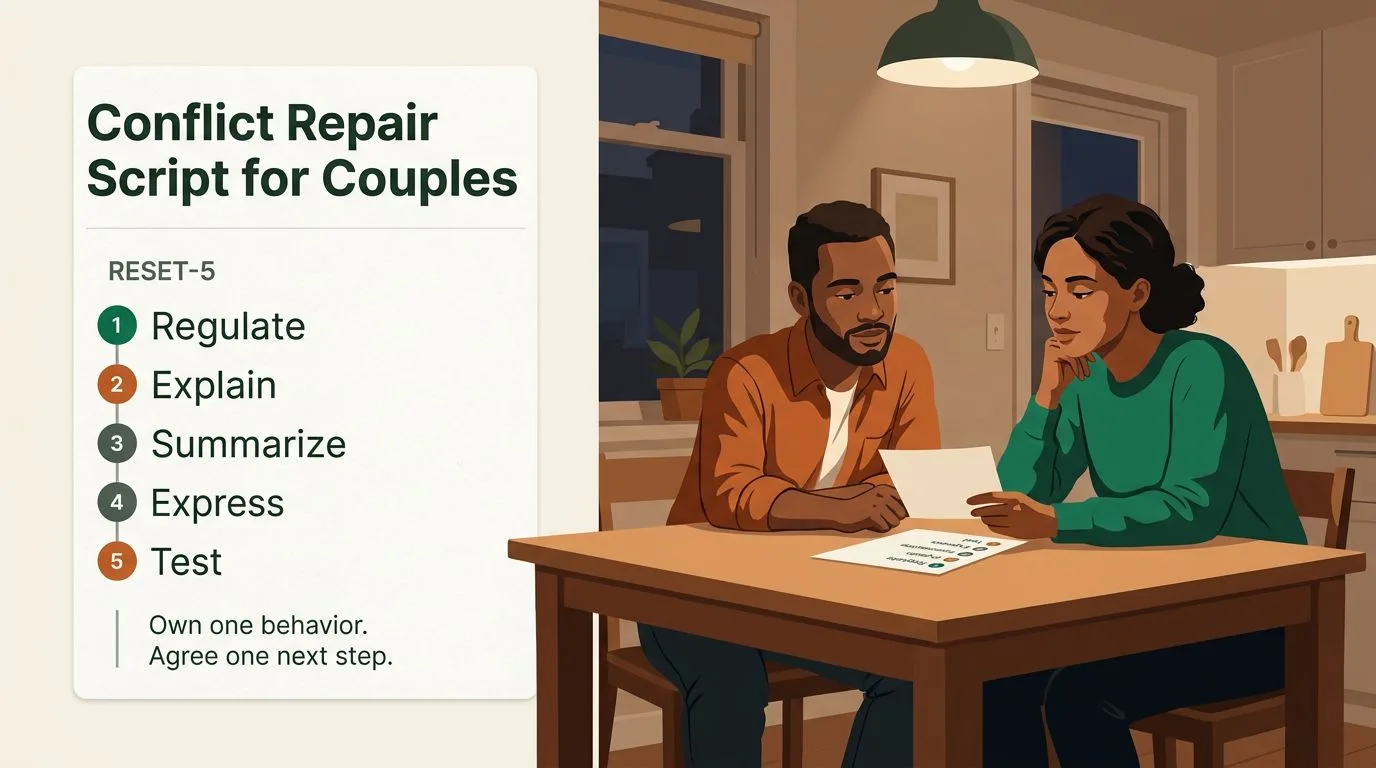
Quick answer: use the RESET-5 repair script
- Regulate before you restart.
- Explain your part clearly.
- Summarize your partner's concern.
- Express your core need in one sentence.
- Test one next step and a review time.
Opinionated take: most repair attempts fail because people jump to justification before ownership. If your first line protects your intent, your partner hears defense, not repair.
Messy reality note: even a good repair script can still fail when one or both of you are exhausted or overloaded. That does not mean the relationship is broken. It usually means the timing window is wrong and you need a shorter restart later.
Why repair conversations derail even when both people care
After conflict, both people usually feel misunderstood and emotionally exposed. That makes fast rebuttal feel safer than accountability. If you restart in debate mode, old evidence piles up and the new conversation collapses.
A useful repair is narrower: one recent moment, one shared understanding, one testable next step. This is why short structures beat long speeches after a fight.
The RESET-5 framework explained
RESET-5 stands for Regulate, Explain, Summarize, Express, Test. It is designed for post-conflict repair, not for proving who was right.
- Regulate: Start with a reset request before content. Example: "I do not want us stuck in this loop. Can we restart this more calmly for 10 minutes?"
- Explain: Own one specific behavior you did. Skip broad self-defense.
- Summarize: Reflect what mattered to your partner and how it landed.
- Express: Name your core concern in one sentence with no blame labels.
- Test: Pick one concrete behavior for this week and set a check-in day.
Copyable conflict repair script 1: harsh tone during an argument
"Can we reset for 10 minutes? My part was speaking sharply and interrupting you. I can hear that it made this feel unsafe and one-sided. My core concern is that we solve this without tearing each other down. For this week, if either of us hears a sharp tone, we pause for five minutes and restart. Can we check how that went on Sunday night?"
Copyable conflict repair script 2: last-minute plan change
"I want to repair last night, not re-fight it. My part was changing plans late and not updating you early. I get why that felt disrespectful and unreliable. My concern is that we both feel considered when plans shift. This week, if either of us will be more than 20 minutes late, we text as soon as we know. Can we review it after dinner Friday?"
Quick chooser: repair now, schedule later, or send a short text opener?
- Repair now if both of you can stay on one issue for 5 to 15 minutes.
- Schedule later if one person is flooded, rushing, or clearly shutting down.
- Send a short text only to reset and schedule: "I want to repair this well. Can we do 10 calm minutes tonight?"
If your first repair attempt escalates again
Do not force completion just because you started. Recovery beats stubbornness in post-conflict moments.
- Pause 10 to 20 minutes once tone climbs.
- Restart with step one and narrow to one sub-issue only.
- If text is spiraling, move to live talk. If live talk is spiraling, schedule a specific follow-up window.
- If opening itself keeps causing defensiveness, start with this calmer opening guide before restarting repair.
What to avoid in a repair conversation
- "I am sorry, but..." turns repair back into argument.
- "You always..." moves from one moment to character attack.
- "Can we just move on?" asks for closure before trust is repaired.
- Stacking old fights in one repair window overwhelms both sides.
30-second repair check before you start
- Did I own one concrete behavior instead of explaining my intent first?
- Did I reflect what mattered to my partner in plain language?
- Did I keep this to one issue and one request?
- Did we pick one observable action and one review time?
FAQ: conflict repair script for couples
What if my partner says the repair attempt is too late? Acknowledge the timing directly instead of arguing it. Then offer one repair action you can do now and one follow-up check-in this week.
Should conflict repair happen by text or live conversation? Use text for a short reset opener or to schedule a time. For meaningful repair, a brief live conversation usually works better.
What if we restart and escalate again? Pause early, narrow to one issue, and restart with step one of RESET-5. If tone stays high, reschedule rather than forcing resolution while flooded.
How long should a conflict repair conversation be? Aim for 5 to 15 minutes. End with one testable action and a specific review time so the repair is behavioral, not only verbal.
For deeper prep around apology wording, see this apology framework. For recurring maintenance, use weekly relationship check-in questions. If the recurring issue is especially sensitive, combine this script with the sensitive-topic guide for calmer starts.