Quick answer: use the 10-minute script framework
- Ask for a short time window and name one topic only.
- Describe one recent moment and its impact on you.
- Ask how the same moment felt from their side.
- Use a reset line if tone spikes.
- Agree on one small action to try this week.
Many talks go wrong in the first two turns, not because the topic is impossible, but because people start with stacked issues and labels.
Trying to solve three grievances in one conversation is the fastest way to trigger a fight. One recent moment plus one clear request is easier to hear and easier to answer.
A lot of people think fights start when disagreement starts. Usually they start when one person hears accusation before they hear the issue.
Need help starting the conversation?
Reflect privately first. Share only what you approve. Start with calmer words instead of a raw first draft.
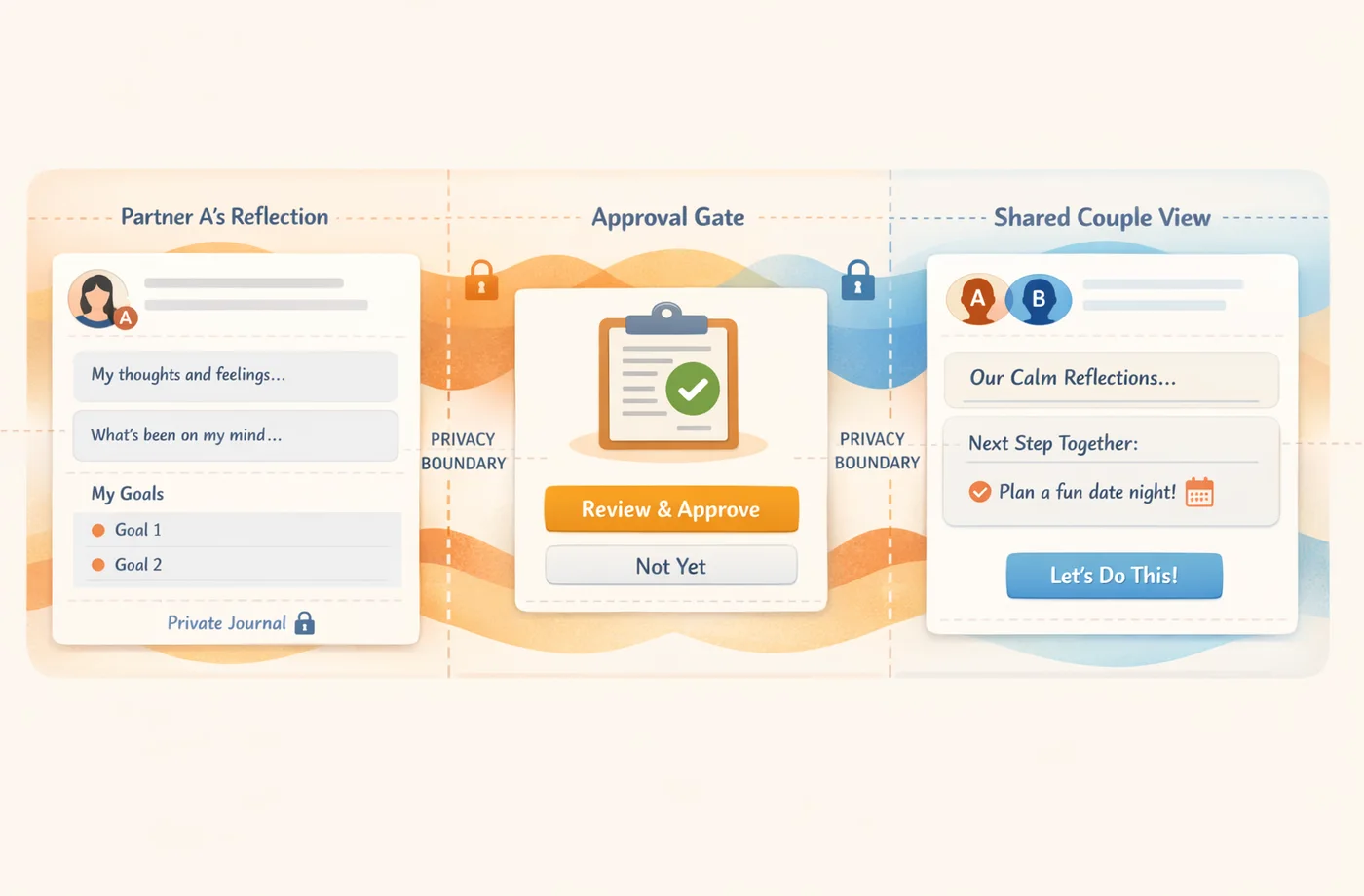
1. Private reflection
Write the raw version first where only you can see it.
2. Approve what gets shared
Review a calmer draft and edit before anything is sent.
3. Share one clear next step
Send a focused opener with one practical action to test.
30-second pre-check before you start talking
- If either of you is visibly flooded, delay the talk by 20-30 minutes.
- If you have more than one issue, pick only the one that matters most today.
- If the topic is mostly logistics, solve logistics first and emotions second.
Quick opener chooser (20 seconds)
- If you feel blamed, start with one impact sentence and ask one question.
- If your partner feels blamed, lead with shared intent before naming the issue.
- If both of you are tense, use the reset line first, then continue one topic only.
The no-fight framework
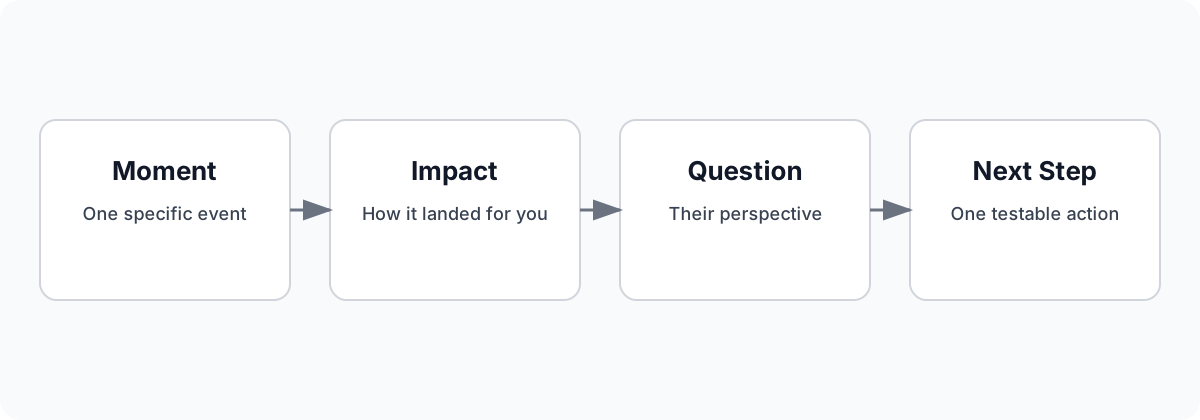
When talks get tense, this sequence keeps the issue concrete and prevents the conversation from turning into a character debate.
- Moment: one specific event, not a character judgment.
- Impact: how it landed for you, in one sentence.
- Question: one genuine check-in about their perspective.
- Next Step: one practical action you can test this week.
How to talk when emotions are high
Before you start, write one sentence you can say out loud: "Tonight I want us to agree on what happens if plans change after 6 PM."
Use this opener formula: moment + impact + request
Start with what happened, then how it affected you, then what would help next time. Skip global labels like always and never.
What to say when your partner gets defensive
Defensiveness is common. The goal is not to win the moment, but to lower threat so the conversation can continue.
- Start with: "I am not trying to blame you. I want us to understand this better together."
- If tone rises: "Can we pause for two minutes and restart with one issue only?"
- If they shut down: "Would you rather do this later tonight for 10 minutes? I care about doing this well, not fast."
Use this check-in question before defending yourself
Say: "How did that moment feel from your side?" This single line often lowers defensiveness because it signals collaboration, not prosecution.
Use this reset line if the tone spikes
"I want us on the same team. Can we restart this part more calmly?"
End with one concrete next step and a time to revisit it
Decide one action for the next 7 days and when you will review it. Example: If either of us will be 20+ minutes late, we send a quick update right away, then check in on Sunday night.
What not to say if you want to discuss problems without fighting
- Do not stack three old arguments into one opener.
- Do not open with labels like selfish, dramatic, or impossible.
- Do not use absolutes like always and never.
- Do not end with vague lines like "we need to do better."
- Do not force a full resolution when either person is clearly flooded.
When not to have the conversation
Timing is half the outcome. Even good wording fails when the window is wrong.
- Do not start in the middle of work, childcare, or late-night exhaustion.
- Do not start when either person is already highly activated.
- Do not start when you cannot stay on one topic for at least 10 minutes.
- Do not start serious repair by text if nuance is the main issue.
A simple 10-minute script you can use tonight
- Can we take 10 minutes tonight for one relationship check-in?
- When ____ happened, I felt ____.
- How did that moment look from your side?
- I want to avoid blame and solve this together.
- Can we try ____ this week, then check in on ____?
Mini scenario: the same issue, two different starts
Before
"You never care about my time, and I am done explaining this."
After
"When dinner plans changed at 8 PM, I felt dismissed. Next time, can we send a quick update if plans shift?"
If your partner reacts with "You are overreacting," use: "Maybe so, but I still want us to solve it. Can we pick one fix for this week?"
If you use the script and it still goes badly
Sometimes you say the calm version and your partner still reacts badly. That does not mean the structure failed. It usually means timing, stress load, or old unresolved context is still too high.
In that case, pause and reset. Pick one smaller sub-topic, shorten the window, and restart later instead of forcing one big repair conversation.
FAQ: how to bring up an issue calmly
What if my partner shuts down?
Lower pressure first: "I care more about understanding than finishing this right now. Can we do 10 calm minutes later tonight?"
What if we start arguing anyway?
Use the reset line immediately, pause for two minutes, and return to one topic only. If tone stays high, reschedule instead of forcing a finish.
Is texting better than talking?
Texting is useful for a calm opener or scheduling. For emotional nuance and repair, a short live conversation usually works better than a long text thread.
How long should the conversation be?
Start with 10 to 15 minutes. End with one next step and a follow-up time. Short, repeatable check-ins usually work better than one long, exhausting talk.
Related communication guides
- How to bring up a sensitive topic with your partner
- Rewrite a hard message more gently
- Conflict repair script for couples
If you want a recurring routine after this, use weekly relationship check-in questions.