Quick answer: use the WINS weekly check-in
- Wins: what felt good between us this week?
- Irritations: what felt tense, unclear, or unresolved?
- Needs: what practical help do we each need next week?
- Small experiment: what one behavior will we test this week?
Opinionated take: consistency beats intensity for couple communication. One short weekly check-in usually prevents more conflict than one long emergency talk after resentment has already built up.
Even with good questions, some weeks will still feel awkward or snappy because work stress, childcare load, or poor timing spills into the conversation. That is normal. The goal is steady repair, not perfect tone every time.
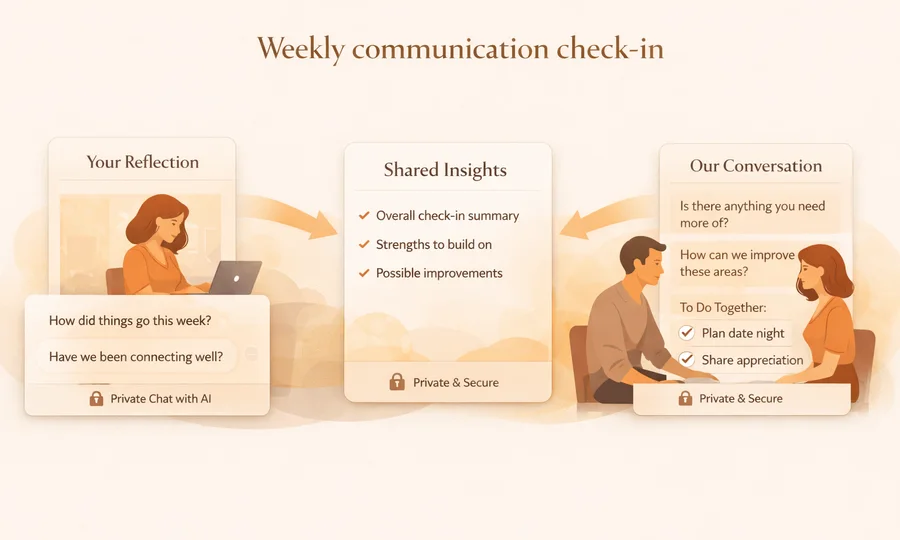
The WINS framework explained
WINS stands for Wins, Irritations, Needs, Small experiment. It keeps weekly relationship check-in questions focused so you do not drift into a courtroom replay of old fights.
- Wins: Name one moment that felt connected, supported, or kind. This lowers threat and reminds both people what is working.
- Irritations: Pick one recent moment that felt off. Stay concrete and skip labels like always, never, selfish, or dramatic.
- Needs: Ask for practical support in plain language. Specific requests are easier to act on than vague frustration.
- Small experiment: End with one behavior to test for seven days, then review next week.
Weekly relationship check-in questions you can use tonight
- What felt good between us this week?
- Where did you feel misunderstood or alone?
- What moment this week made you feel most supported?
- What moment still feels unresolved?
- What practical help do you want from me next week?
- What boundary or expectation needs clarification?
- What one small change should we test before our next check-in?
If seven prompts feels heavy, start with only four: one win, one friction point, one request, one next step. Depth on one issue is more useful than rushing through a longer list.
Two copyable examples (exact words)
Example 1: schedule changes
"My win this week was our Saturday morning walk. One irritation was Tuesday when dinner plans changed after 7:30 and I felt dropped. Next week, can we text each other as soon as plans shift? Let's test that for seven days and review on Sunday."
Example 2: tone during conflict
"I appreciated that you asked how my meeting went. I still feel tense about last night when our voices got loud. I need us to pause when tone spikes. Can we test a five-minute reset rule and then continue one topic only?"
30-second setup before each check-in
- Choose a recurring time with low interruption risk.
- Set a 15-minute timer to keep it contained.
- Put phones down and keep one speaker at a time.
- Agree that you are solving one week, not relitigating your whole relationship history.
What to do if the check-in escalates
Name the escalation early: "We are slipping into attack mode. Can we reset and stay with one question?" Then choose one of these recovery moves:
- Narrow to one recent moment and drop older examples.
- Take a five-minute pause if either person is flooded.
- Resume with one request and one next step, not a full autopsy.
- If both people stay activated, reschedule and restart later.
If you need post-argument repair first, use the conflict repair script for couples.
Common mistakes that make check-ins useless
- Turning check-in time into a scorecard of every old grievance.
- Using personality labels instead of specific moments and requests.
- Skipping the final action step, so nothing changes between check-ins.
- Trying to solve three major topics in one 15-minute window.
- Using the check-in to win arguments instead of improve next week.
FAQ: weekly relationship check-in questions
What if one partner says check-ins feel forced?
Shorten the format to 10 minutes and keep one topic only. Most people resist the idea of a long emotional session, not a brief practical reset.
What if the check-in turns into a fight?
Pause, name it, and continue with only one question. If tone stays high, reschedule instead of forcing all prompts in one sitting.
How many questions should we ask each week?
Four focused prompts are enough for most couples. You can use the full seven-question list on calmer weeks when you have more bandwidth.
Should we do relationship check-ins by text?
Text is useful for scheduling and a gentle opener. For emotional nuance, a short live conversation is usually better than a long thread.